poetry, proza

The Perfect Love

I’d give you the perfect love
and the wretch, without which there would be no perfect love
I’d give you a night that has yet to be born
and morning with vile intentions that has not happened yet

I’d give you lavishly morning in the wasteland
I would given you all the sweet languages
and all the shapes that were slowly matured in me

I’d give you them, wolves and jackals
and Beethoven’s Ode to Joy
and Belgrade on fire from which I
managed to escape,
roasted, skinned and cooked
I would give you Heaven and Hell

I’d give you the fire
and the quiet joy
and the child’s language

All that is both happy and sad
and wounds that emerge from the mud
and my childhood
and my father whose hands killed me twice
and his words were rubbed into the places that hurt

I’d give you my luxuriously morning in the desolation
and feeble tail surfaces in the text
and truncated chairs in my poems

I’d give you everything!

Standard
poetry, proza

My Ode To Serbia!

it is like a desert where time is not measured by clocks
It is similar to the opening through which the jailer peers into a cell
it is why the birds for me have no name
it is the cause of my timid disruptions
it is the cause of my demolished kingdoms
It is a creature not known to human heart
staying in my words unspoken.
SERBIA.

Standard
poetry, proza

Terry Robinson (HE George), UK (England) And the Writing’s on the Wall, Commentary by Leila Samarrai

From cave pictures, with hand
sprayed self portraits.
To a church’s pulpit displaying
Psalm Twenty Three.
The writing’s on the wall

From mud huts to stately
homes.
The writing’s on the wall

From the nail driven torso
hanging from the eaves.
To bullet chipped, blood
soaked wall of the firing squad
The writing’s on The Wall

From the cleaved head. That
reminisces Salome’s deed.
To a child’s barrel-bombed and
desecrated body. Too
late to share its uncorrupted
mind.
The writing’s on The Wall

And from the push of the first
button to the
push of the final button.
There will be NO writing on
the wall

Is that the writing we want
for us?
The world is at war. Humanity
is in flames.
And I have tears. But, nowhere
to cry.

~* ~

Commentary by Leila Samarrai: This amazing, well-crafted poem doesn’t contain the usual rhetoric related to terrorism such as descriptions of bloody shouts, strong shocks, gas masks, or bombs. The voice of this fantastic poet, Terry Robinson, shows through seemingly unrelated metaphor on the effects of terrorism throughout time. I see this history through images ranging from the head of John the Baptist, the pierced body of ‘homo erectus’, to the poor infant in the ancient days of Sumerian Civilization in Mesopotamia. I see shattered heads; I escape Salome’s wrath; and I walk through the epochs, through history. These words and images are united in their marrow, and all this is accompanied by the mantra, “The writing’s on The Wall”, that will echo in my ears, maybe forever. This phrase emphasizes his point that mankind has a propensity for violence or terrorism and this nature is the ‘writing on the wall’, or something that cannot be changed. A good poet often transcends genre or topic, and here, images and words fly through the ages, transcending time until the dystopian end when the poet turns to his own humanity, as well as to the remains of the world, surrounded by ruins, in the manner of a post-apocalyptic hero when he writes: ‘/ The world is at war. Humanity is in flames. / And I have tears. But, nowhere to cry /’. The poet conveys a universal message that the world is changing, but the scenery remains the same. The room for interpretation is not immense, but it is ambiguous, seemingly without hope or even a small opening through which one can cry and breathe. A circle has neither a beginning nor an end: it is one single, continuous line, a never-ending cycle without progress, where the past is endlessly repeated.. ‘until he comes out at the beginning’ (Fishman). Or, should I quote Jim Morrison, ‘This is the end, My only friend’.

Frosini, Fabrizio. POETRY AGAINST TERROR (Kindle Locations 2280-2284). Fabrizio Frosini.


Standard
poetry, proza

Mai Venn, Ireland, The Music Stopped, ~* ~ Commentary by Leila Samarrai


Thunder rolls from guns were observed,
Mutilated young bodies
Arranged in red locks across the crowded
room,

Shock, dismay and carnage,
Weeping tears mixed with speechless
teens,
Surrounded by extraordinary slaughter,
Bewildered young people, damaged for
life.

Why? That is the question.
Will we ever get answers to this mystery?
Is it a mystery or an event foretold?
What did it all accomplish?

Media hype to drive Europe into
submission.
Did it work?
That is another question.
Who will give us this response?

The grim reaper of death, mingled
amongst them,
Who gathered the bleak harvest of souls.
Newsflash on our radios and televisions,
The world looks on, helpless and
disturbed.

Each country wondering, ‘Will we be
next?’
All feel heart-rending emotion for France.
We express grief with them and for them,
May their loved ones rest in peace.

~* ~ Commentary by Leila Samarrai:

Like Virgil leads Dante through hell, Venn leads the reader through a bloodstained Paris, using strong and convincing poetic images. Through a picturesquely woven artistic structure, the poet has strung together harsh images that create the feeling of the current existence in France and the world. The title, ‘The Music Stopped’, reminds us how we felt when the attacks occurred, and also refers to the massacre during a music concert. The symbol of ‘The Grim Reaper’ is used, reminding us that souls are being gathered as we look on, ‘helpless and disturbed’. The image also reminds us that we do not know who will be next, where the next terrorist attack will occur and who will be killed. The poem ends in an unsettling note of ambiguity and sadness for the victims with the last line ending, ‘May their loved ones rest in peace’.

Frosini, Fabrizio. POETRY AGAINST TERROR (Kindle Locations 2789-2796). Fabrizio Frosini.


Standard
poetry, proza

Douglas Stewart, USA Mourning, Marchons, ~* ~ Commentary by Leila Samarrai

Douglas Stewart, USA
Mourning, Marchons

Arms they hid beneath their cloaks,
Intent beneath facades of peace,
And fixed their paths toward Montrouge,
A concert, and 130 dead Parisians,
a City Mourning, Marchons.

The City of Light knew then its friends,
they
Rallied from the clovered corners of the planet,
The tears of auld allies and former colonies glisten,
Late enemies stood next to Marianne,
hands clasped in
Mourning, Marchons.

Current adversaries promise support,
old friends
Pledge support and, as 70 years ago, is
Paris Burning?
NO!
The City of Light lifts her torch,
Marianne sings,
Her standards of law and justice remain t
he same. Even in Mourning, Marchons!

~* ~ Commentary by Leila Samarrai:

The poem, ‘Mourning Marchons’, has the character of an anthem as it invokes archetypal images of France to condemn terrorism and to celebrate the best aspects of a country dedicated to liberty. The term ‘Marchons’, references ‘Le Marseillaise’, the national anthem of France, and reminds us all to never give up or despair despite great hardship. The poem opens, in the first stanza, reminding us of the human beings who were murdered by terrorists in Paris. The poet brings ‘Marianne’, an allegory of liberty and reason and a portrayal of the Goddess of Liberty, to life, and reminds us of the famous image by Eugene Delačrois, where Freedom leads the people (” La Liberté guidant le peuple”), conjuring up feelings of power, freedom and victory. The poet calls on the ‘/ marching, even in mourning /’, evoking the final victory of freedom and justice over pain and death. This poem reminds us that despite all that has been lost and is being mourned, France will never change: ‘/ her standards of law and justice /’ will prevail.

Frosini, Fabrizio. POETRY AGAINST TERROR (Kindle Locations 2593-2598). Fabrizio Frosini.


Standard
proza

Leila Samarrai: Svrha života

https://belegbg.wordpress.com/2016/01/09/leila-samarrai-svrha-zivota/

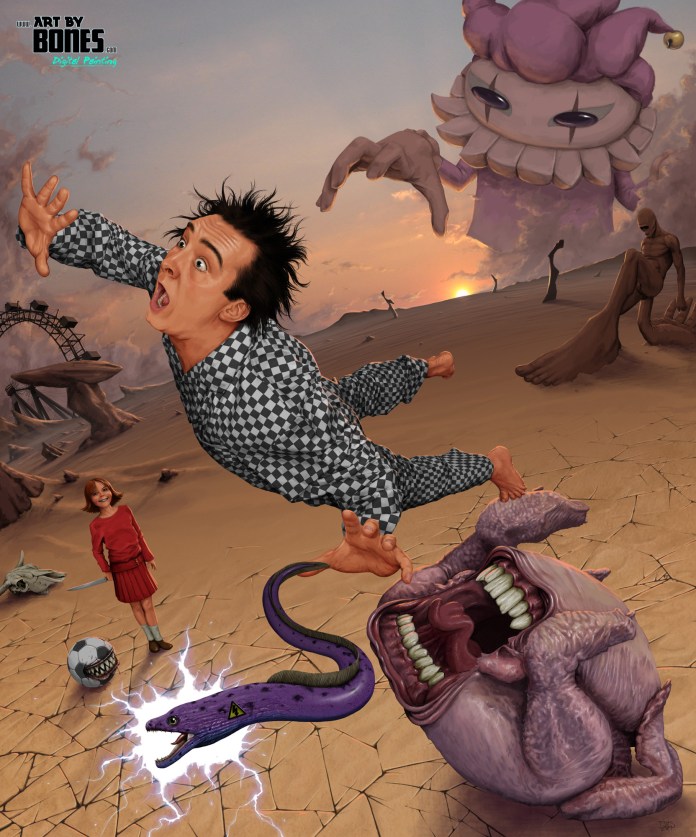
Jednog dana, Boris K. došao je do zaključka da je uradio sve što je mogao na ovome svetu. Rekao je glupom da je glup, licemeru da je licemer, sebičnom da je sebičan, budali da je budala. Te noći, u snu mu se javilo neobično biće sa pačjim kljunom i perajima i reklo:

„Nisi uradio sve što si mogao, Borise… Nisi se pokrio jorganom od kože banjipa, mitskog bića starih Aboridžina. Kad ustaneš, jorgan će ti biti na dohvat ruke, a nakon toga, srešćeš mudraca koji će ti pomoći da ispuniš svoju životnu svrhu.“

Kad se probudio, Boris K. ustanovi da je umesto ćebetom prekriven jorganom od kože banjipa u koji se umota, drhteći…

Pogledavši se u ogledalo, ustanovi da ima lice psa, da su mu zubi ispali, a kljove iznikle. Okrenuvši se, primeti i to da mu je izrastao konjski rep. Nemajući kud, Boris K. reši da sačeka Mudraca. Umesto njega, došao je komšija Vasa, koji ga je odveo na pečenje.

weird_dreams_by_artbybones

Standard
biography, proza

Who am I?

Who am I?
16
Full name Lejla Samaraj Mehdi (Mehdi Leila Samarrai)
Born on 19 October 1976 (39 yrs.)
Place of birth: Kragujevac, Serbia, Yugoslavia
She studied Spanish language and Hispanic literature. She made her debut in 2002, winning the competition for the first book of the Student Cultural Centre in Kragujevac. In addition to the Serbian language, the less works are published in Hungarian and Spanish. She lives and works in Belgrade.
Greater achievements:
The Darkness Will Understand (collection of poems), Student Cultural Center, Kragujevac. 2002. ISBN 978-86-7398-010-2.
The Dolls (drama play), a library of “Contemporary Serbian drama” electronic edition, Project Rastko, 2009
The Adventures of Boris K. (story collection), “Everest media”, Belgrade. 2013. ISBN 978-86-7756-028-7.
Shorter acts:
She published stories in a journal “The shortest parable”(” Alma”, 2010) and in magazines “Quarter”, “Mons Aureus”, “Rhinoceros” and “Steps”, in printed form
Her prose works, poetry and aphorisms were published in electronic form within the more specialized websites: “Project – the Library of Serbian Culture”, “Balkan Literary Gazette,” “The Creative People Network”, “Belegbg”, “Jovo Nikolic”, “Rhinoceros “,”Zetna”,”Afirmator”,”Helly Cherry”, and others.
Awards and recognitions
– won third place as a representative of Serbia for aphorism “Stars and us” on the Beleg competition
– won three awards on the story competition “3-5-7” as a part of the “Helly Cherry” competition
– “The Darkness Will Understand”, book of poetry, “The Firstborn Edition”, Student Cultural Center, first prize winner
– won three awards in the competition “357 – A story in moment”, Belgrade, 2011.
– won third place for a fantastic aphorism “Stars and us”, 2011 (as a representative of Serbia)
-won third place in the competition of “Beleg” for short fantastic story, 2011.
(source: Wikipedia)
Standard
poezija, proza

Leila Samarrai, Serbia Où vas-tu, Seigneur?


A happy game
a first strike
with a ball
in Paris
a first turn
then
turn around
play begins
in Paris

“Où vas-tu, Seigneur?”
The crying stops
the laughter stops
the clocks stop
the dance stops
the ball stops
in midair
breaths are held
the seeds of terror sown
in Paris
“Mais, où étais-tu, Seigneur?”
The jackals and scoundrels
are exposed..
to a fallen mankind
It is the end of the world.
It has begun..

~*~

Commentary by Valsa George Nedumthallil:

As a bolt from the blue, when terrorists abruptly unleashed terror on a group of people who had gathered in the concert hall to spend one evening in joy, they were stupefied by a horror too deep for expression! The poet here has captured that freezing moment in all poignancy. The clocks suddenly stopped and time stood still; the music stopped and the pall of gloom suddenly fell..! Through broken images, the magnitude of the crime and its impact are successfully conveyed. The day is almost like an apocalypse or Doom’s day. The poet denounces the attack as a scoundrels’ act and wonders if the world is falling into the hands of a pack of scoundrels!

Standard
interview, proza

Leila Samarrai: A good writer is one who is not afraid to speak out interviewed for “Afirmator”, the magazine for the arts and social issues, by Tamara Lujak

http://afirmator.org/leila-samarrai-dobar-pisac-je-onaj-koji-se-ne-boji-da-progovori/

The master of of the short story, Leila Samarrai is both published and
award-winning young author. She loves to write, she lives for the
literature, she dreams about having her own manager, like
American writers. Inspired by the Monty Python, by Chaplin, by
everyday situations in our country, she creates sharp, funny,
satirical stories, full of liberating rage and bitterness. Dive into
her world, for a moment…

What is the task of the writer?

The task of the writer is to write well and that’s all. It seems to me
that this is the striking thesis of Joseph Brodsky.

Why do you write?

For pleasure, and because I believe that I have something to say…

Where do you get your ideas?

Is simply, when I hit the table with my fist, a genie from the magic
lamp appears, bowing down to me, saying: “I beg your pardon,
my Magistra Ludi” Then I express my desire which is, immediately,
fulfilled.

11046933_1584598361784951_3934123044165569558_n
What is a good poetry/art and how would you define a poetic
skill?

Art is a game. Poetry is a game. At the end of the day, either
you know how to play or not…

What is a good writer to you?

A good writer is the one who is not afraid to speak up; the one who
dictates the art of the written word. A writer who only scribbles
in silence collecting praises is nothing but an idle reader. He to
whom the written word is flowing through the wounds in the
world descending to the paper, he does not hesitate to give either
criticism or praise. It is his aspiration.

What is the best literature and the purpose of art?

The survival of the human race.

Where did you get the idea to write Boris K (“Everest media”,
Belgrade, 2013)?

In the age of absurd events in Serbia, which go against common
sense, it was not difficult to come up with the idea to write an
absurd satire which would reflect the reality in the witch’s “old
woman Valentina” mirror . Pythonesque burlesque in conjunction
with Kafkaesque atmosphere, in the spirit of Monty Python and
perhaps Chaplin or SF passenger through space and time, are just
some of the references that build the atmosphere. Why
Kafkaesque? Because Boris K. in spite of his Johnny Bravo
powers and abilities is just plain, small, but not so common man,
milled by the wheel of the kafkaesque torture machine “in the
penal colony” – which grinds and bites, in a sophisticated way, but
it… kills … Johnny Bravo effect, the muscles of superhero are
part of the comedy of the absurd. The hyperbole that I like to use,
sometimes to the extreme, is part of the comedy and the comedy,
so to speak, becomes even more comical.

Can we expect a continuation of The Adventures Of Boris K?

Yes, you can. Ideas ideas everywhere.. (I share Plato’s thought), Boris K. is not only the satire – short story hero, he is an omnipresent avatar representing disruptive, although an imaginative cosmopolitan. He deserves the best assembled fable, the beginning, the plot, my favorite peripetia and spicy denouement with a touch of bitter irony at the expense of society.

What are you currently doing?

Like a sculptor, I am chiseling a novel made up of interwoven narratives, fighting for each sentence. This work does not require precision in terms of the well formed plot. It is itself a sleepwalker fantasy in which the vigilant one walks in the dream. It is surreal, like moonwalking…
The title is “The Sleeping Matilde”. It has something magical in it, for me… It follows my narrative sensibility focused not only to action but on shading of complex characters in novel. It has the characteristics of magical realism and’m good at it and I am endlessly enjoying in my work.
Melpomene

Tips to the younger writers?

Go not by the beaten paths. Break the patterns and remember that Kafka, who was the genius, was very unsure of himself. He thought he did not know to write, which he covered up by his famous hysterical laughter when urged to read aloud his works to his friends… Also, he wrote late into the night. This advice does not apply to you if you’re an early riser 🙂

translated from Serbian into English: Leila Samarrai

Standard
proza

The Sermon on the Mount, author: Leila Samarrai, The Adventures Of Boris K.”, part two

Boris K. warned about false conversions during his Crucifixion hereinafter of his adventures “The Adventures Of Boris K.”, part two

Blessed are the poor in mind for they shall get the degree of the public university!
Blessed are those who already eat for they shall be fed!
Blessed are the rich for they will get a bail!
Blessed are those with dirty imagination for they will see the action!
Blessed are the peacemakers, for they will take care of us all!
Blessed are the persecuted for they will inherit the free parcels of land!
Rejoice, you shall be rewarded in heaven, but the award is an overeating at the expense of the corporate expense now and immediately in forever and ever. Amen!

Boris K.

Standard